
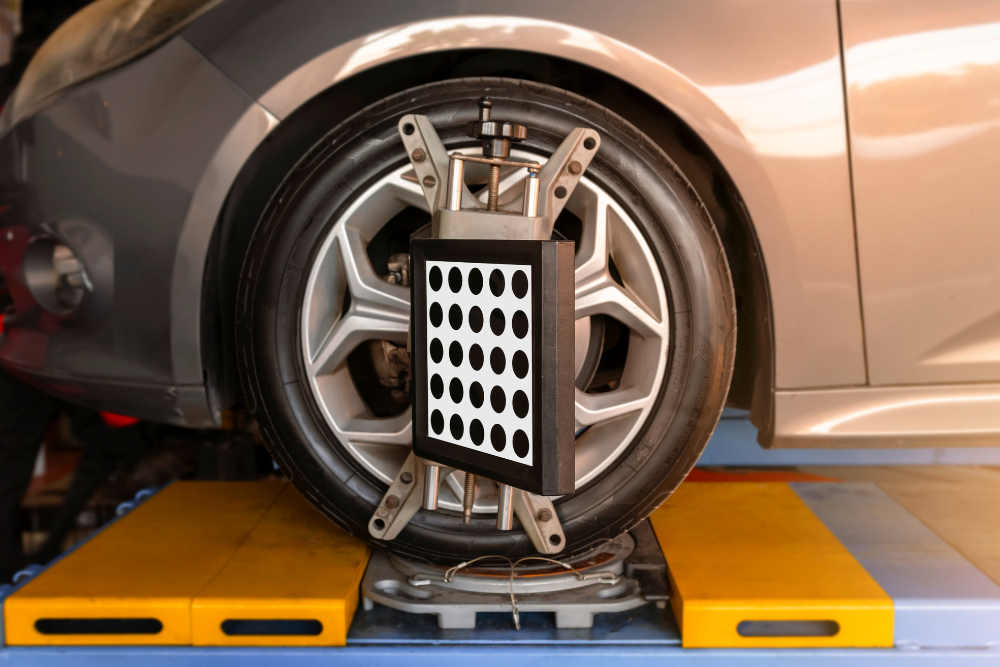
If you’ve ever wondered whether a wheel alignment is truly complete without an ADAS recalibration, the short answer is no. At KIT’S Auto and Truck Repair in Woodbine, MD, we use a Hunter alignment system to measure your vehicle’s geometry with precision, but the job doesn’t end when the tires are pointing straight. Modern vehicles carry cameras, sensors, and radar units that depend entirely on that geometry to function correctly. When the angles shift, so does the reference point every safety system uses to interpret the road ahead.
Understanding why these two services are linked can save you from a safety risk that most drivers in Carroll County never think about. It starts with physics.
What Wheel Alignment Changes
Most drivers think of alignment as a tire service. In reality, it is a geometry service. When an automotive technician adjusts your alignment, they are changing the precise angles at which your tires contact the road: camber, caster, and toe.
Those adjustments correct pulling, uneven tire wear, and handling drift. But they also shift the physical orientation of your entire front end, and sometimes your rear axle. Everything bolted to that structure moves with it:
- Forward-facing cameras
- Radar sensors behind the grille
- Side-view assist units in your mirrors or bumpers
Each of those devices was calibrated at the factory to operate from a fixed reference position. Move the vehicle’s geometry, and you move their line of sight.
The Thrust Angle Explained
Here’s the concept that connects alignment and ADAS most directly: the thrust angle.
Your vehicle’s thrust angle is the direction your rear axle actually pushes the car, measured against the car’s true centerline. On a perfectly aligned vehicle, the thrust angle is zero. The rear pushes exactly where the front is pointed.
When it’s off, even by a fraction of a degree, the vehicle is physically traveling in a slightly different direction than the steering wheel suggests. Now consider what your lane-keeping camera sees. It is mounted to a body pointing in one direction while the car travels in another. If the thrust angle places the car 1.5 degrees off center, the camera may calculate that the car is centered when it is actually drifting toward the line.
At highway speeds, that angular error can translate to several feet of positional misread in seconds.
What Happens When Cameras Are Not Recalibrated After an Alignment in Woodbine
Your forward-facing camera feeds data to automatic emergency braking, lane departure warning, lane centering assist, and adaptive cruise control. Each system makes decisions based on where the camera believes the vehicle is positioned.
If the camera’s aim was not reset after your alignment:
- Lane departure warning: may alert you to a crossing that isn’t happening, or stay silent during one that is.
- Automatic emergency braking: may brake for a vehicle not on a collision path, or miss a real threat due to positional offset.
- Lane centering assist: may apply corrections that push the car toward the line rather than away from it.
- Adaptive cruise control: may target the wrong vehicle if the forward radar is aimed slightly outside the lane.
None of these failures announce themselves with a warning light. The only indication may arrive in the moment the system needs to act.
Why Carroll County Drivers Face This Risk More Than They Realize
The roads around Woodbine, Mount Airy, and Westminster are not uniform. Rural stretches, highway transitions, and varying pavement conditions can shift your alignment over time without you ever noticing.
A few factors that compound the risk locally:
- Seasonal temperature swings in Maryland put stress on suspension components throughout the year
- Curb strikes and gravel road vibration gradually shift alignment angles without obvious symptoms
- Most drivers don’t schedule alignment checks until they notice pulling or uneven tire wear: by then, drift may already be present
If you’ve had alignment work done at another shop and ADAS recalibration was not mentioned, your safety systems may be operating on outdated reference data right now.
Not sure if your ADAS systems were recalibrated after your last alignment? Visit us at KIT’S Auto and Truck Repair, 603 Wedekind Dr Building C, Woodbine, MD 21797, or call us at 240-270-0077 to schedule a check.
Static vs. Dynamic Calibration: What the Process Looks Like
ADAS recalibration comes in two forms. The right one depends on the system and the manufacturer’s requirements.
| Static calibration | Dynamic calibration | |
| Where it happens | Controlled indoor environment | On the road while driving |
| How it works | Targets placed at precise distances; software resets the sensor’s zero point | System reads real lane markings and environmental data at set speeds |
| Space required | Yes: flat floor, controlled lighting | No fixed location needed |
| Can it work alone? | Yes, for many systems | Not always: some manufacturers require static first |
| Applies to | Most camera and sensor systems | Select systems by make and model year |
Some vehicles require both. The requirements vary by make, model year, and the specific system being recalibrated.
Why Proper Equipment Is the Difference Maker for ADAS Work
ADAS calibration is only as accurate as the tools used to perform it. Placing a target three inches off center produces a calibration that is three inches off center.
Our team uses Autel diagnostic equipment that supports ADAS recalibration across a wide range of makes and models, including the European vehicles and commercial vans we see regularly from the Woodbine area. Precise alignment measurement through our Hunter system and proper recalibration tooling means the geometry correction and sensor reset work together. We also use a Snap-on scanner to confirm module communication and verify recalibration was accepted before the job is closed.
How KIT’S Auto and Truck Repair in Woodbine Handles Both Services Together
When you bring alignment and ADAS work under the same roof, the process connects the way it should. Our automotive technicians verify your alignment with the Hunter system, perform recalibration to manufacturer specifications, and confirm the vehicle’s systems are communicating correctly before it leaves the bay.
KIT’S Auto and Truck Repair is a NAPA AutoCare Center, which means qualifying repairs are backed by a 2-year/15,000-mile warranty on parts and labor. We are always straightforward about what your vehicle needs. If recalibration is required, we will explain why and show you the data. If it is not required for your specific vehicle, we will tell you that too.
Why Woodbine Drivers Trust KIT’S Auto and Truck Repair for ADAS Work
We handle alignment and ADAS calibration as a connected process, not two separate jobs. Every service is backed by honest communication and the tools to do it right.
- NAPA 2-Year/15,000-Mile Warranty: Qualifying repairs are covered by a nationwide NAPA AutoCare warranty on parts and labor.
- ASE-Certified Technicians: Our team includes ASE-certified technicians, confirming they meet nationally recognized standards.
- VW Master Technician on Staff: Our owner carries a VW Master Technician credential, reflecting a high level of specialized diagnostic training.
- NAPA AutoCare Financing: Financing is available through NAPA AutoCare via Synchrony for qualifying repairs.
- Autel Diagnostic Equipment: We use Autel tools capable of ADAS recalibration across a wide range of makes and models.
- Hunter Alignment System: Our Hunter alignment machine delivers precise geometry measurements before any recalibration begins.
- On-Site Waiting Area: A comfortable waiting area is available for customers who prefer to stay while their vehicle is serviced.
FAQs About ADAS Calibration and Wheel Alignment
Do I need ADAS calibration after an alignment?
Yes, in most cases. Alignment changes your vehicle’s geometry, which shifts the reference point your cameras and sensors use. If those systems are not recalibrated, they may operate on incorrect positional data.
What happens if my cameras are not calibrated after an alignment?
Your lane-keeping, emergency braking, and adaptive cruise systems may respond to incorrect data. The error is not always visible as a warning light, making it a hidden safety risk.
Who does ADAS calibration in Carroll County?
KIT’S Auto and Truck Repair in Woodbine performs ADAS calibration using Autel diagnostic equipment. Not every shop in the area is equipped to handle both alignment and ADAS recalibration together.
How do I know if my ADAS system is out of calibration?
Often, there are no obvious symptoms. The most reliable indicator is whether recalibration was performed after any alignment, suspension work, windshield replacement, or front-end collision repair.
Does every vehicle require static or dynamic calibration?
It depends on the make, model, and which system is being recalibrated. Some require static only, some dynamic, and some require both. Manufacturer-specific procedures determine the correct method.
Schedule Your Alignment and ADAS Recalibration Today!
If your vehicle has recently had alignment work done, or you are due for an alignment and your car carries any of the safety systems described above, do not leave calibration to chance.
Reach out to KIT’S Auto and Truck Repair at 603 Wedekind Dr Building C, Woodbine, MD 21797. Call us at 240-270-0077 or schedule online to set up your appointment. Our team is ready to make you the next happy customer by making sure your vehicle’s safety systems are working exactly the way they were designed to.